

According to French historian Jacques-Oliver Boudon, the fates of Napoleon Bonaparte and the frigate Medusa were interestingly intertwined.
Le Radeau de la Meduse
Can SARIÇOBAN
According to French historian Jacques-Oliver Boudon, the fates of Napoleon Bonaparte and the frigate Medusa were interestingly intertwined.
The royal system came to an end thanks to the revolution of 1789, and many different forms of government were tried thereafter. While the turmoil of the First French Republic continued, Napoleon Bonaparte seized power in 1804, proclaimed himself emperor, conquered many parts of Europe, and continued the revolutions in full force in many areas. However, things soon began to go wrong. After his final defeats, Napoleon was exiled to the island of Elba near Italy, and King Louis XVIII came to power, restoring the monarchy. This is known as the “First Restoration”. However, Bonaparte managed to escape from the island, return to Paris, and seize power once more. He remained in office for 111 days and continued fighting, but this time suffered a decisive defeat at Waterloo. Following this final defeat on 18 June 1815, the Bourbon dynasty re-established its rule, and Louis XVIII returned to the throne. This is also called the “Second Restoration”. Napoleon was first placed on the island of Aix in northern France, then left his fate to the British fleet at the port of Rochefort and imprisoned on the island of Saint Helena off the coast of Africa. It was clear that King Louis XVIII had collaborated with the enemy in order to regain power. These events signified the failure of the revolution, and the glimmer of hope that had emerged among the people would be extinguished for a time. The royal administration purged all Bonapartists and republicans from the country, placing loyalists in positions of power without regard for merit.
According to French historian Jacques-Oliver Boudon, the fates of Napoleon Bonaparte and the frigate Medusa intersected in an interesting way. The construction of this massive ship had begun during Napoleon’s reign, when he sought to strengthen the navy, and the Medusa Frigate was completed in 1810. François Ponée, a highly experienced captain, was appointed to command the ship, and the Medusa Frigate had achieved great success until Bonaparte was overthrown.
Almost a year after the defeat at Waterloo, the Medusa frigate, now under royal control
, set sail from the French island of Aix on 17 June 1816 with 400 passengers and crew, bound for the Senegal colony, which the British had ceded to the French, crossing the same seas as the ship that had exiled Napoleon. Among the passengers on the Medusa were the governor of Senegal with his family, various officials, soldiers, scientists and servants. Chaumareys, appointed to replace the experienced captain, was inexperienced and incompetent but fiercely loyal to the Crown. This was precisely what the new regime wanted: to create loyal, anti-heroes…
Indeed, the new captain followed the instructions of certain royal officials to the letter, changing the course to speed up the journey despite the objections of some passengers and officers on board. On top of that, he had entrusted the navigation of the ship to a passenger named Richefort, a member of a charitable organisation belonging to the monarchy, and had declared that God was on their side. While Richefort, who had no interest in seafaring, observed the surroundings, Captain Chaumareys was comfortably entertaining “high-ranking” people in the saloon.
The 74-metre-long, 1,500-ton Medusa frigate, travelling at full speed in the dangerous waters off North Africa, where reefs and sandbanks were present, reached increasingly shallow waters on 2 July 1816. Neither Richefort nor Chaumareys had noticed the clear signs that the sea was getting shallower. Had they jettisoned the ship’s heavy cannons or some of the provisions, they might have had a chance of survival, but the captain and governor refused to do so. As a result, the ship ran aground completely and soon began to crack.
The lifeboats on board could only accommodate 250 people. The captain, the governor, royal officials, high-ranking soldiers and the “benevolent” navigator, along with their families, were the first to board these lifeboats. According to the emergency plan, a large raft would be built from the ship’s sturdy parts, and the remaining 150 people, including many scientists, soldiers, and servants, would board it. The governor of Senegal, who spearheaded the plan, announced that for safety and comfort, they had designed the raft to accommodate 200 people. The boats would pull this raft with a rope and take it to a safe shore. This raft, cobbled together with various parts of the Medusa frigate, such as masts, planks and ropes, which was still being shaken by the ocean waters and in danger of breaking apart, was not as safe and comfortable as it was said to be. Even with only 40-50 people on board, part of the raft sank. Those who hesitated to board were forced onto it at gunpoint. In order for the raft to take the rest of the survivors before it sank completely, many supplies, including a barrel of water, were thrown overboard. Apparently, in the rush, a barrel of water was thrown instead of wine. As a result, all that remained on the raft was a few boxes of biscuits and a barrel of wine to feed 150 people. The lifeboats, however, were loaded with boxes of supplies and valuables. Among these items, the most interesting was undoubtedly the governor’s favourite armchair. He had not even taken his secretary onto the lifeboats, sending him to the ship instead. Unable to believe what was happening, the secretary repeatedly tried to jump from the ship to the lifeboats but was prevented from doing so. While this chaos was unfolding on the ship, those in the lifeboats watched the events unfold from a distance, indifferent.
Finally, the boats began to move forward by pulling on the ropes. The boat, which was moving slowly through the water, was in danger of capsizing. After a while, those in the boats thought that the boat was slowing them down and decided that cutting the rope would increase their chances of survival. As the rope was cut, shouts began to be heard: ‘Long live our king, long live our king!’
Until the lifeboats were well away, those on the raft did not believe the rope had been cut. Suddenly, great shock and fear took hold of the entire raft, and chaos reigned once more. Unable to bear it, more than twenty people threw themselves into the ocean waters in the first few hours. The boxes of biscuits, their only food, were soaked through. Stranded under the scorching African sun with nothing but soggy biscuits and a barrel of wine, these people were hopeless and helpless.
As the waves grew higher, the raft tossed those sitting near the edges overboard. The survivors constantly fought to move to the middle section. As a result, dozens of people drowned or were killed. As time passed and the biscuits were completely gone, the survivors began to eat their leather belts, hats, or clothes. A few times, they managed to catch some herring they came across. However, this was nowhere near enough to feed everyone. As the days passed, the survivors had no choice but to eat the flesh of their dead companions. They sliced human flesh and dried it in the sun to eat, sometimes mixing it with the remaining fish meat to make the taste less repulsive. They were forced to add some seawater and urine to the dwindling wine barrel.
By the eighth day, only 27 passengers remained alive; most were seriously injured. Some had lost their sanity and begun to hallucinate. To ensure the remaining wine would last a few more days, they decided to throw the most seriously injured passengers overboard. In the days that followed, the 15 half-naked men who remained were unable to move. The sun had scorched their bodies, their lips had turned to sponge from thirst, their eyes had lost their sparkle, and their faces were unrecognisable. About four days later, on 17 July, a ship appeared on the horizon. It was the Argus, the other ship that had set sail for Senegal with the Medusa. Those who had the strength climbed onto the barrel, supporting each other, and waved a piece of cloth so that those on the Argus could see them. However, the ship did not notice them and sailed away. This last hope that had kept the survivors alive vanished in an instant, and a great despair took hold once more. A few hours later, the Argus frigate returned and rescued the shipwrecked. Of the 15 people rescued, 5 died shortly afterwards from overeating and drinking too much water.
Captain Chaumareys returned to the wreckage of the damaged frigate Medusa with a team to retrieve valuable items. He had no intention of searching for the people he had left behind. However, 17 people who had jumped from the raft in the first moments swam back to the frigate and miraculously managed to survive for 54 days.
The negligent captain, who had made numerous navigational errors and caused the deaths of over a hundred people by abandoning ship before all passengers were safely rescued, should have been executed according to the laws of the time. However, Chaumareys, who was fond of the king, got off with a mere three years’ imprisonment, a laughable sentence.
This incident shook the French public, who were already seething with anger over the failure of the revolution, so deeply that the disaster was discussed for days, with metaphors drawn between this catastrophe and the state of the country. The cruel and foolish royal administration, irresponsible and arrogant rulers, hunger, misery and the “lower class” people abandoned to death…
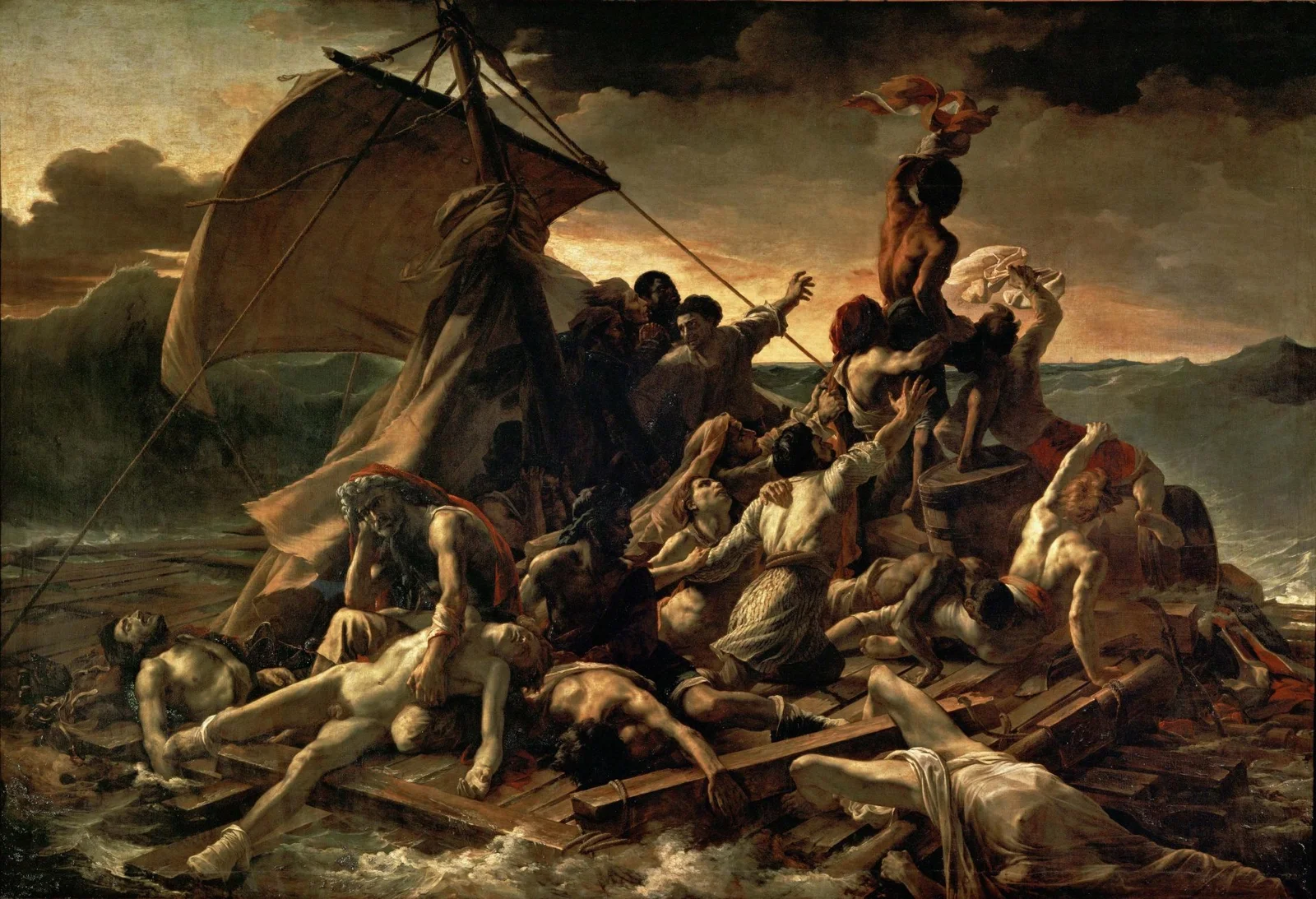
This sensational event naturally had a profound effect on artists. In 1818, the 25-year-old painter Théodore Géricault decided to create a work depicting this event. He gathered all the news reports about the accident, contacted eyewitnesses and learned the details of the event in all its starkness. Just two years after this scandal, he produced the work “The Raft of the Medusa” to commemorate this tragedy. While the work shows the influence of neo-classicism in form and essentially romanticism, its subject matter presents us with precursors to the realism movement that would emerge after the 1850s.
The Medusa frigate disaster parallels the failure or incompleteness of revolutions, the collapse of Napoleon’s Empire, and the incompetent and outdated governance of the Bourbon dynasty that succeeded it in many areas. Therefore, it is not surprising that a political meaning was attributed to this event and, indirectly, to the painting “Tuesday of the Medusa”. However, the true achievement of the Romantic painter Géricault lies in the powerful emotions he imbued in the work. When examining this enormous painting (4.91m x 7.16m) on display at the Louvre When examined starting from the left corner, it depicts death and helplessness through the exhausted survivors and the father holding his son’s lifeless body; as one moves towards the right, it evolves towards hope and strength with the depiction of relatively more energetic and armed people. The dark waves surging on the left side of the painting and the ship appearing on the bright horizon on the right support this narrative. In contrast to the grey-green corpses that Géricault predominantly painted on the left side of the painting as a result of his extensive research in the morgue, the people on the right side seem to have become one body, pointing to the Argus Frigate appearing on the crimson horizon. With its pyramidal structure and arrangement of figures, the painting seems to show unity with Eugène de Courrot’s famous painting “Liberty Leading the People”, created in memory of the 1830 revolution, while confirming the principle of the unity of opposites in terms of content. On one side, the monarchy that devastated its people is depicted, while on the other, the people’s reclaiming of power is portrayed. However, in both paintings, the calamity and death brought about by famine and power struggles are evident.

Subscribe to the Psikeart Email Bulletin!
Subscribe to our Bulletin
Thank you for subscribing to the newsletter.
An error has occurred. Please try again.