
Consider a concept… One that has found its place in medicine, psychology, history, literature, sociology, philosophy, religion, politics, cinema, and photography… Hunger…
Hunger and History
İlker Garipoğlu
Consider a concept… One that has found its place in medicine, psychology, history, literature, sociology, philosophy, religion, politics, cinema, and photography… Hunger…
Since the dawn of humanity, hunger has been man’s most fundamental driving force. This urge cannot be stopped or eliminated, but it can be satisfied. Because hunger has been a fundamental problem for humans since day one, we live in a civilisation based on where to satisfy our hunger, which environments are more suitable for living, and how to protect those environments from others. Before the formation of today’s civilisation, prehistoric times were divided into periods based on the nature of the food consumed. In the Palaeolithic period, food needs were met through hunting and gathering. With the establishment of settlements in the Neolithic period, agricultural activities began, and the majority of food needs were met with agricultural products. It would be inaccurate to think of these early periods as a magnificent harmony and complementarity between humans and nature. Those periods also saw cold, drought, floods, fires, thirst and hunger, which were painful experiences for humanity. Anthropological research shows that thousands of famines were recorded in China from 100 BC to the early 1900s.
In the universal flow of life, which shows unity through the opposite meanings of concepts, where there is food, there is fullness, and where there is fullness, there is hunger. Hunger is sometimes a situation chosen by human will, and sometimes a situation experienced beyond one’s will.
World War II and the ‘Minnesota Starvation Experiment’
Historically, the Second World War, which took place between 1939 and 1945, changed the course of the world in political, cultural and economic terms. It is important not to reduce this significant war to merely a territorial struggle between states. This period also witnessed important experiments in terms of human history. One of these was the ‘Minnesota Starvation Experiment’.
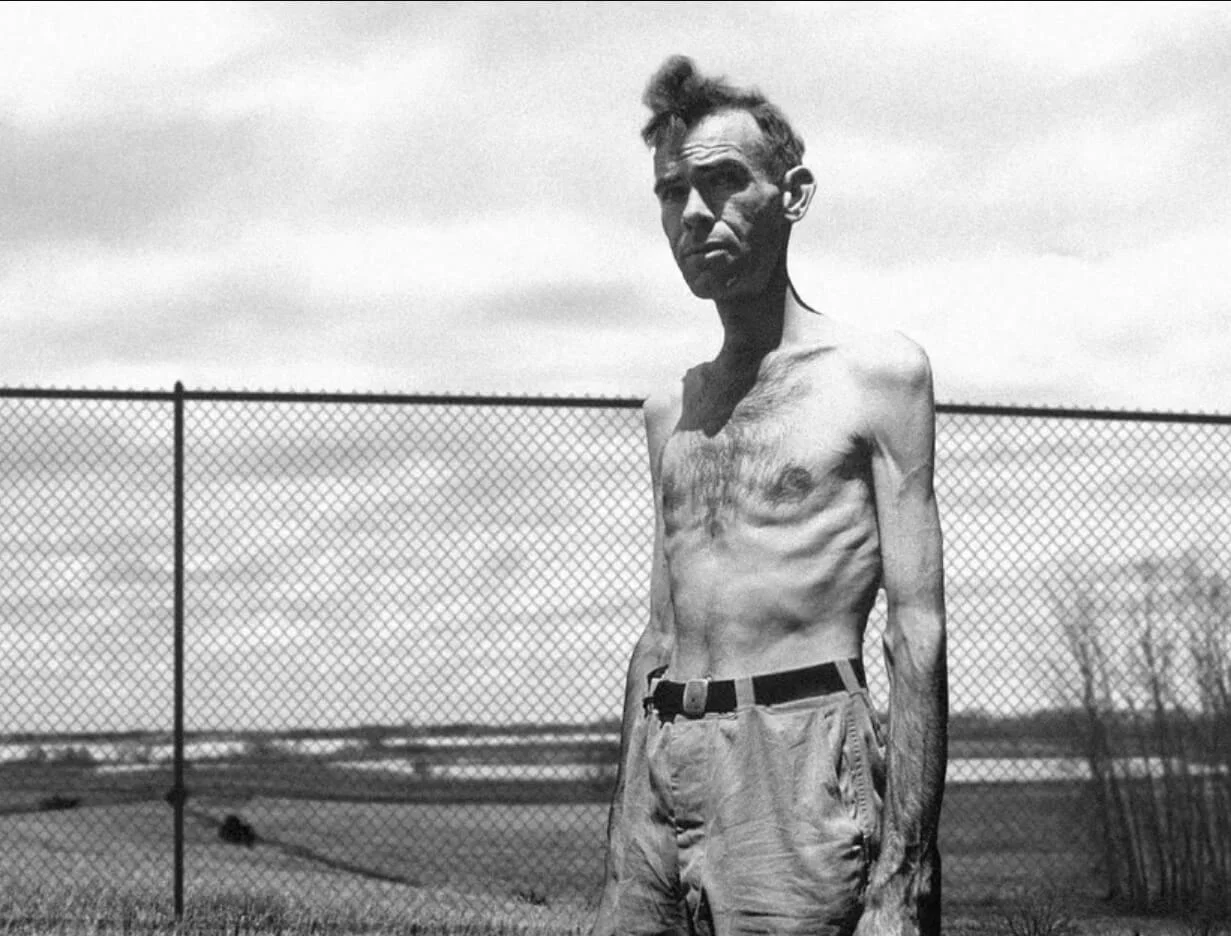
During World War II, Europe was struggling with famine. The US Army sought to understand their struggle with hunger, restore their lost nutrition, and comprehend how to treat people in Europe suffering from famine and scarcity. There was only one way to do this: conduct a starvation experiment on healthy individuals. The experiment would be carried out by the University of Minnesota, established in the United States in 1851. They printed and distributed leaflets explaining the subject and purpose of the experiment. Marshall Sutton, a leading anti-war conscientious objector who strove to make the world a livable place in every respect, and hundreds of other conscientious objectors like him volunteered for the experiment. The subjects were selected from healthy men on a voluntary basis. The experiment began in November 1944 with thirty-six people, including Marshall Sutton. This study, conducted in history, was an important experiment on the psychological and physiological effects of starvation. Participants selected from the United States and the United Kingdom who applied for the experiment were given two very low-calorie meals a day, without meat, throughout the experiment. The goal was to make people lose at least one kilogram per week. Those who failed to lose the targeted weight had their calorie intake reduced. Despite receiving very few calories, they were required to burn them off. Physical activity, such as walking and running, was therefore mandatory. During physical activity, the subjects were deliberately led past food shops. Upon seeing the food shops, most participants withdrew from the experiment. Those who remained began to experience psychological and physiological problems resulting from significant weight loss. The subjects’ hair fell out, their hands and feet swelled, they became anaemic, felt cold, and became depressed and restless. After the experiment ended, it took at least a year for the subjects to regain their former health.
Hunger Strikes in History
A hunger strike is a non-violent method of resistance and protest initiated by an individual against injustice and the system or people causing it, when they feel they have been wronged. The individual voluntarily stops eating. As they lose weight and become weaker, they believe they gain spiritual strength.
The history of hunger strikes dates back to ancient times. According to ancient Irish custom, a person who had suffered injustice would stage a hunger strike in front of the door of the person who had wronged them. It is said that Saint Patrick (385-461), considered a holy figure in Ireland, fasted in his temple to seek forgiveness from God or the victim for the injustice he had suffered. The day and month of Saint Patrick’s death, 17 March, was declared Saint Patrick’s Day by the Irish people. Every year on 17 March, Saint Patrick’s Day is celebrated with great enthusiasm in Ireland.
Mahatma Gandhi
Mahatma Gandhi was born in India in 1869. He left Indian soil and became known throughout the world as the most important example of passive resistance with his anti-violence views. He sometimes went on hunger strikes to rebel against the system and sometimes to purify himself spiritually. He went on hunger strike for the independence of India under British rule. Faced with a three-week hunger strike protest, Britain backed down and recognised India’s independence.
Fasting in the History of Religions
Throughout our historical journey since the dawn of humanity, we encounter the culture of fasting in all tribes and religions. Fasting or abstinence has existed in human life as a form of worship, self-discipline, and energy enhancement.
The Sumerians, who hosted many civilisations in Mesopotamia and left their mark on history with the invention of writing, had a culture of fasting. According to the religious beliefs of the ancient era, God revealed his sacred teachings only to those who fasted for a certain period of time through dreams and visions.
It is also possible to find interesting information about fasting in Greek mythology. According to Greek and Roman cultural beliefs, fasting could be used as a precaution against disasters that might befall them from the gods.
According to Buddha, the only thing that prevents Nirvana is desire. Salvation can only be achieved by abandoning desires, and the first way to get rid of desires is to fast.
A Photograph of Hunger
How long did you look at a photograph, or how long could you look at it, while experiencing all the pains of existence? While looking at that photograph, could your soul bear the unbearable weight of existence?
Kevin Carter and the unforgettable photograph of hunger… Photojournalist Kevin Carter went to the region in March 1993 to document what was happening in Sudan. A small child, emaciated from hunger, his bones visible, collapses from exhaustion; he tries to reach the United Nations feeding centre, literally ‘crawling on the ground’. At that very moment, a vulture, seeing the child as prey, moves behind him and waits. Photographer Kevin Carter captures that moment and leaves the area after pressing the shutter. The photograph he took earned him the Pulitzer Prize in 1994.
He became the target of criticism for taking the photograph and leaving without helping the child. In his defence, he stated, ‘I was not an aid worker, I was a photographer, and besides, we were forbidden to touch them due to infectious diseases.’ While some supported Kevin, others criticised him.
A year after taking the photograph, on 27 July 1994, he committed suicide in his car.
That photograph is a document, a proof of hunger and helplessness… Were you able to look at it?
References
1) Joachim Radkau, Nature and Power: A Global Environmental History, Translated by Nafiz Güder, Türkiye İş Bankası Kültür Yayınları, Istanbul 2017.
2) Massimo Montanari, The History of Food in Europe, Translated by Mesut Önen & Biranda Hinginar, Edited by Özden Arıkan, Alfa Publishing, Istanbul 1995.
3) Server Tanilli, History of Civilisation, Cumhuriyet Books, Istanbul 2017.

Subscribe to the Psikeart Email Bulletin!
Subscribe to our Bulletin
Thank you for subscribing to the newsletter.
An error has occurred. Please try again.