
The Power of Photography
The Power of Photography
Mehmet Ömür
Most articles about photography begin with a definition of photography and refer to writing in this light based on the meaning of the words. However, I thought it would be more appropriate to explain the subject by moving away from the specificity of photography and referring to images, visuals, pictures, and even 24 photographs shown one after another in 1 second, i.e. moving photographs.
Painting or Photography?
There was a slogan for a while that referred to the relationship between photography and painting: ‘Paintings are made, photographs are taken.’ However, a photograph is also a painting. It is the representation, the depiction of the image from our external world, not with a brush and paint, but through a machine. Mehmet Yılmaz’s book, ‘Photography is Painting,’ beautifully refutes this slogan. The book quotes lyrics from a song by Aysel Gürel. In her song ‘I Haven’t Written That Song Yet,’ Aysel Gürel sings, ‘My hand didn’t tremble at all, as if they weren’t you. I took the pictures down from the wall one by one.’ There are other songs like this too. Here’s a section from Erol Evgin’s song ‘That’s Just the Way It Is’:
Like when you look at an old photograph
Like when you count the years
Like when your eyes suddenly fill with tears
That’s what it’s like, that’s what it’s like.
Finally, from Cem Karaca, Tears in the Picture:
One day, perhaps from life
From days gone by
You’ll seek solace
Look at my picture then
See those flowing tears
All that remains of me for you now
Is a small picture
It cannot answer, but
It weeps for its loneliness
Whose tears are these, shed for a beloved? The word ‘picture’ has become synonymous with “photograph” and, in these days when taking selfies is fashionable, has also entered our language as ‘Shall we take a picture?’
The Power of Photography
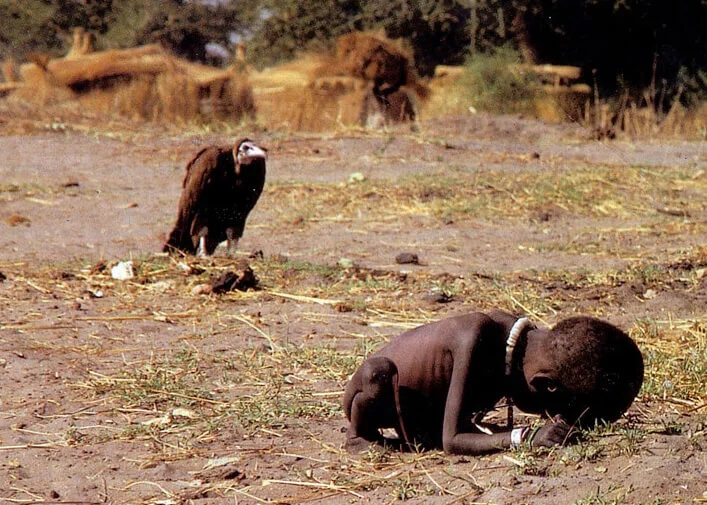
When I hear the phrase ‘the power of photography,’ Kevin Carter’s photograph ‘Vulture and Child’ immediately comes to mind. Kevin Carter won the 1994 Pulitzer Prize for this photograph, and three years later, he committed suicide. The photograph shows a vulture waiting for a child dying of starvation to die. Most people think of the vulture, if not the photographer chasing the photograph. When you see the photograph, the first thought that comes to mind is, ‘What an unscrupulous photographer, taking pictures instead of saving the child.’ Then, sensitive people think of ‘the problem of hunger in the world.’ In fact, as with every photograph, there is a visible and an invisible part to this photograph. This is inherent in the nature of photography; the photographer, sometimes by choice and sometimes out of necessity, includes certain subjects in the frame and leaves others out. Kevin Carter did not include the child’s relatives waiting in the food queue just beyond the child in the frame, portraying the child as if abandoned to death. This photograph, which was the subject of lengthy debate in the press, and the photographer’s already fragile mental health, led to the photographer’s death. The child also died of malaria 14 years later.
If the subject were not ‘Hunger,’ I would begin with a very fresh image of the power of photography. I would put the photograph of George Floyd, with an American police officer kneeling on his neck for 8 minutes and 43 seconds, at the top of the list here. These images are so powerful that they began to create a feeling that could almost lead to revolution in the United States. At the very least, they sparked a level of anger that could have changed the outcome of the elections. We, too, felt breathless as we looked at the photograph. Billboards were plastered with George’s image alongside the phrase ‘I CAN’T BREATH’.
I don’t think it’s possible that those in power didn’t take these into account. Photography is such a powerful tool that it can lead not only to changes in power but even to the end of wars. Here are two photos. These photos raised awareness among the American people, increased anti-war movements, and played an important role in the government’s decision to end the war.
When we look at these photos, we feel anger, sadness, and even shed tears. That is how powerful a photograph is. However, since the advent of Photoshop, and perhaps even long before that, photographs have been manipulated and deliberately made to tell lies. This is done for various purposes. They can be used in advertising, political campaigns, as a propaganda tool, or in art. Here are a few examples.
The photograph was discovered in 1839 and received state funding for the invention of the French photographer Daguerre. A few years later, Hyppolite Boyer, who made significant progress in photographic technique, took a photograph depicting himself as having committed suicide in the river to protest the lack of state support for his work. This photograph was the first manipulation of a photograph. The year was 1840, just one year after the invention of photography.
Later came Henry Peach Robinson’s photograph entitled ‘Fainting Girl’. Using five different negatives in 1858, he achieved a perfect image for the conditions of the day and told the story in his head, even if it was not true. Today, there is no limit to the lies told through photographs using Photoshop. We no longer know which photographs to believe. Photographs are now viewed with suspicion. They are used as a tool for propaganda.
If you would like a few examples, here they are: some politicians are trying to pass off the 30 people behind them as 3,000.
The photograph that opened Europe’s doors
The most recent example is that of Aylan baby, who washed up on the shore in Bodrum, prompting Europe to open its doors to migrants.
This is the power of photography. Photographs have lives. Régis Debray touches on this subject in his work The Life and Death of the Image. I hear you asking, do images die? The death here is more the death of our gaze than of the image itself. As our faith in photographs diminishes, we tend to glance at them and move on. Of course, where there is no gaze, there is no image, or it dies. Just as there is no sound where there are no people. Does a leaf falling in a forest where there are no people make a sound?
When we talk about the power of photography, there are also those who take revenge through photographs. Here is the story of a model, whose name need not be mentioned, and her ex-boyfriend who shared sexually explicit videos of her on social media to take revenge. In the early 2000s, it became the focus of all the press and proved the power of the image in this regard.
Advertising, cinema, television, computers, even game screens and security cameras – images are everywhere.
Writings on the uniqueness and dissemination of artistic imagery mostly emphasise commercial and/or political aspects. Subsequently, the sensationalism of advertising or journalism is discussed.
The image challenges our imagination with the information it carries. Isn’t everything ultimately a matter of education?
The image imposes itself as reality, yet it possesses all the tools to imitate it: this is clearly seen in photo montages.
Again, the image often fails to achieve artistic richness because it carries a clichéd imagination, just like in advertisements.
The image may violate privacy and serve only commercial purposes; paparazzi are experts in this.
The image has a powerful symbolic concentration and helps us understand: for example, images used in education.
Photojournalism and war photography are an entirely different field, where photography has a universal language.
The image, in addition to capturing the moment, creates a feeling and is an art form in its own right:
Photography is an integral part of daily life.
With its excessive proliferation in our societies, one could argue that the overwhelming presence of photography has led to a numbness of vision, a dulling of our senses. Exercising control over others assigns photography a superior role that encompasses social relations.
According to Susan Sontag, ‘such images have the power to replace reality,’ because initially (it is worth emphasising) photography is not just an image but an interpretation of reality; it is also a trace.
Photography is a power used in the physical sense of ‘having an effect’ or ‘changing behaviour.’
There are photographs that cause pain, kill, excite, and soothe. Photographs that turn your stomach, make your hair stand on end, give you the creeps, make your mouth water, make you cry, and provoke sexuality (it is common knowledge that this is one of the world’s most important industries). inspire certain ideas, spark creativity, influence decisions, make you buy things you don’t need, and get presidents elected. Do we really need to question the power of a photograph that embodies all these characteristics?
Cinema, which stirs emotions to such an extent and is the moving version of photography, is another matter altogether, and there is no need to go into that here.
In his work Vie et mort de l’image, or ‘The Life and Death of the Image,’ Régis Debray examines the impact of words on society before exploring the evolution of the use of images.
Photography claims to be an autonomous field of competence equipped with specific social and political issues. It aims to ensure that the whole world is aware of serious events happening around the world, to raise awareness and spur action. Photography has now moved beyond being a technical tool to becoming an ideological tool. Photography, which was initially the photographer’s choice, has today become a reality that is manipulated more than it is chosen.
The photographic image is no longer an autonomous object; it is an intention, entirely devoted to the service of communication.
Our expectations have changed over time.
We no longer seek the magic or aesthetic value of the image. Instead, we speak of our disappointment with images. The proliferation of images diminishes their value.
Photographs are no longer analysed as photographs; they become ‘signs of the world.’ This brings visual language to the fore. Certain patterns, codes, and logos attempt to facilitate our easy perception of images.
A long time ago, we thought that there was magic in photographs, that we were trying to see the invisible in the image, that the image was related to God or a deity-like exaltation. Later, aesthetics entered into photography.
Now, however, the economic dimension of photographs prevails. In other words, our views on photography change over time.
But now, little by little, we don’t even look at some things anymore. We no longer look at other people, at certain faces; when there are other people in photographs, men, women, landscapes, people, oddities, they tell us something else. In visuals, patterns, logos, advertisements, signs tell us something else. Image inflation or devaluation occurs. Images, photographs, visuals are all mixed up, and we are becoming numb in the face of so many images. We are exhausted. There is a sense of exhaustion, of ending. Should we stop looking? Is that possible? How can we resist this barrage of images imposed on us from all sources? Perhaps these are the questions we need to ask ourselves from now on.
As we watch television, our channel-hopping speed is increasing. Image consumption is accelerating. Soon, we may begin to move from one image to another at the speed of light.
Can our eyes, our perception, even our emotions keep up with this speed? Here, too, I am reminded of the question posed by a native African to a white man. Why are you going so fast? I remember something like, ‘Your soul won’t be able to keep up.’ I saw it in a film.
Are images or words more powerful?
Let’s get to the question of whether words or images are more powerful. Above, we drew attention to the transformations created by some photographs. Words are also very powerful. A clergyman emerges in Jerusalem and writes the world’s best-selling book, turning half the world into his followers. Someone else named Karl Marx says something else, enabling some countries to be governed by their own ideas.
The question of words versus images is a profound one. But it is clear that words, having passed through writing, have given way to images in history, or are about to do so. Although leaders like Hitler, who influenced masses and led societies to their deaths through their words and writings, are newer and occupy a larger place in our memory, images are very important. Even though the words of Luther and some politicians were very effective, they would not be as powerful today without the support of photographs.
There is image, and there is imagination
I would like to conclude by saying, ‘There is image, but there is also imagination.’ Einstein said, ‘Imagination, that is, fantasy, is more powerful than knowledge.’ How beautifully put. I believe it is time to lift our heads out of the nauseating visual pollution, even the visual rubbish heap, and look up at the sky to indulge in a little fantasy.

Subscribe to the Psikeart Email Bulletin!
Subscribe to our Bulletin
Thank you for subscribing to the newsletter.
An error has occurred. Please try again.